How to Measure Your Bra Size for a Perfect Fit
Two measurements, a little math, and you will know your true size in any country's system.
What You Will Need
A soft fabric tape measure is all it takes. If you do not have one, a piece of string and a ruler will work just as well. Measure in your everyday bra or without one, but stay consistent throughout both measurements. Once you have both numbers, plug them into the Bra Size Calculator to get your size across all international systems instantly.
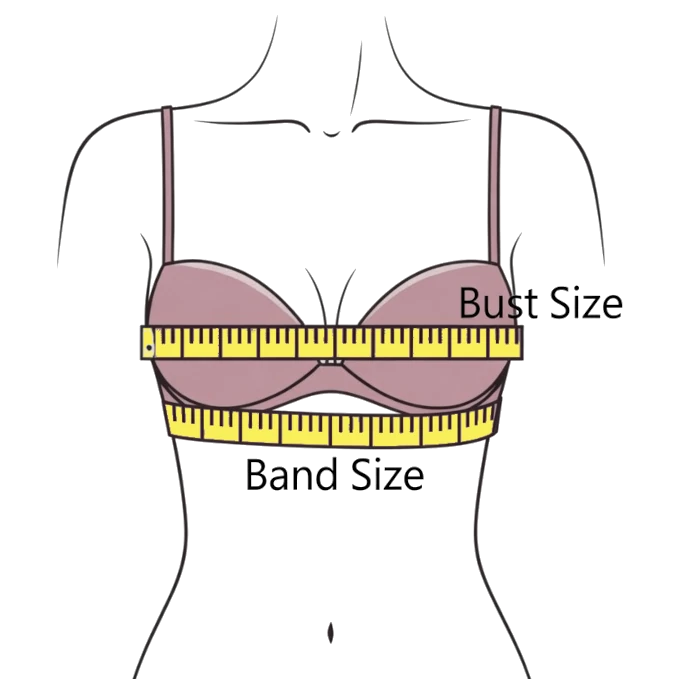
Step 1 — Measure Your Underbust (Band Size)
Wrap the tape measure snugly around your ribcage, directly under your bust. Keep the tape level all the way around and breathe normally. Do not pull it tight or let it sag. Write down this number in inches or centimeters.
This measurement is the foundation of your band size. Different countries use it in different ways:
| System | How band size is derived | Example (28 in / 71 cm underbust) |
|---|---|---|
| US / UK / AU | Underbust in inches (rounded to nearest even number) | 28 |
| EU / Germany | Underbust in cm (rounded to nearest 5) | 60–65 |
| France / Italy / Spain / Belgium | EU band + 15 | 75–80 |
| Japan | Underbust in cm (same scale as EU) | 60–65 |
Step 2 — Measure Your Bust (Cup Size)
Lean forward slightly at about 45 degrees, then wrap the tape loosely around the fullest part of your chest. Keep the tape parallel to the floor. This measurement should feel comfortable, not tight. Write it down.
Step 3 — Find Your Cup Size
Subtract your underbust measurement from your bust measurement. The difference tells you your cup size. The table below shows the US cup letters. For a full cross-system reference, see the Size Chart:
| Difference (inches) | US Cup | UK Cup | EU / FR / JP Cup |
|---|---|---|---|
| Less than 1 | AA | AA | AA |
| 1 | A | A | A |
| 2 | B | B | B |
| 3 | C | C | C |
| 4 | D | D | D |
| 5 | DD | DD | E |
| 6 | DDD | E | F |
| 7 | F | F | G |
| 8 | G | FF | H |
| 9 | H | G | I |
| 10 | I | GG | J |
Tips for a Good Fit
The band does most of the work
About 80 percent of support comes from the band, not the straps. A properly fitting band should sit level all the way around and feel snug but not uncomfortable. You should be able to slide two fingers underneath, no more.
The center gore should lie flat
The small piece of fabric between the cups (called the gore) should rest flat against your chest. If it lifts away or digs in, the cup size is wrong for your shape.
No spillage and no gaping
Your breast tissue should sit fully inside the cup with no spillage over the top or sides. Equally, a cup should not gape or wrinkle. If it does, try a smaller cup or a different cut.
Straps are for comfort, not support
Straps should be adjusted so they do not dig in and do not fall off your shoulder. If you are constantly adjusting them or your shoulders feel sore, the band may be too loose and the straps are compensating.
Try the loosest hook first
New bras should be worn on the loosest hook so you have room to tighten as the fabric stretches over time. If you are already on the tightest hook with a new bra, try a smaller band size.
Understanding Sister Sizes
Sister sizes are bra sizes that contain the same cup volume but with different band and cup letter combinations. Moving up a band size and down a cup letter keeps the same volume:
| Smaller band | Your size | Larger band |
|---|---|---|
| 32D | 34C | 36B |
| 34DD | 36D | 38C |
| 32DDD | 34DD | 36D |
Sister sizing is handy when your exact converted size is out of stock, or when a brand runs slightly large or small in the band.
Now Find and Convert Your Size
Once you have your measurements, use the Bra Size Calculator to find your size, then the International Bra Size Converter to see your equivalent across US, UK, European, French, Italian, Australian, and Japanese sizing systems.
Frequently Asked Questions
Common questions about measuring and finding the right bra fit.
Remeasure every 6 to 12 months, or any time your weight changes by more than 10 pounds, after pregnancy or nursing, or whenever your current bras start to feel noticeably different. Bodies change gradually, and a size that fit well a year ago may no longer be correct.
Either works — the key is to be consistent. If you measure your underbust without a bra, also measure your bust without one (or both with a non-padded bra). Wearing a padded bra for the bust measurement and nothing for the underbust will skew the difference and give an incorrect cup size.
Try both sizes if possible. As a general rule, if your underbust falls between two band sizes, round down for a snugger band (which provides more support) or round up for a more relaxed fit. If you round down the band, also go up one cup size to preserve the same cup volume — this is called sister sizing.
Sister sizes are bra sizes that contain the same cup volume with a different band and cup letter combination. Moving up one band size and down one cup letter keeps the same volume. For example, 34C, 36B, and 32D all hold the same amount of breast tissue. Sister sizing is useful when your exact size is out of stock or when a brand runs large or small in the band.
Brands differ in how they cut, grade, and label their bras. One brand's 34C may fit like another's 34B or 36C. Always use your measured size as a starting point and be prepared to try one size up or down. Checking a brand's own size guide or reading reviews mentioning fit can help narrow it down before you buy.
A well-fitting bra has five signs: the band sits level all the way around and you can fit two fingers underneath but no more; the center gore lies flat against your chest; your breast tissue sits fully inside the cups with no spillage over the top or sides; the cups have no wrinkling or gaping; and the straps stay in place without digging in.